Today's Opinions, Tomorrow's Reality
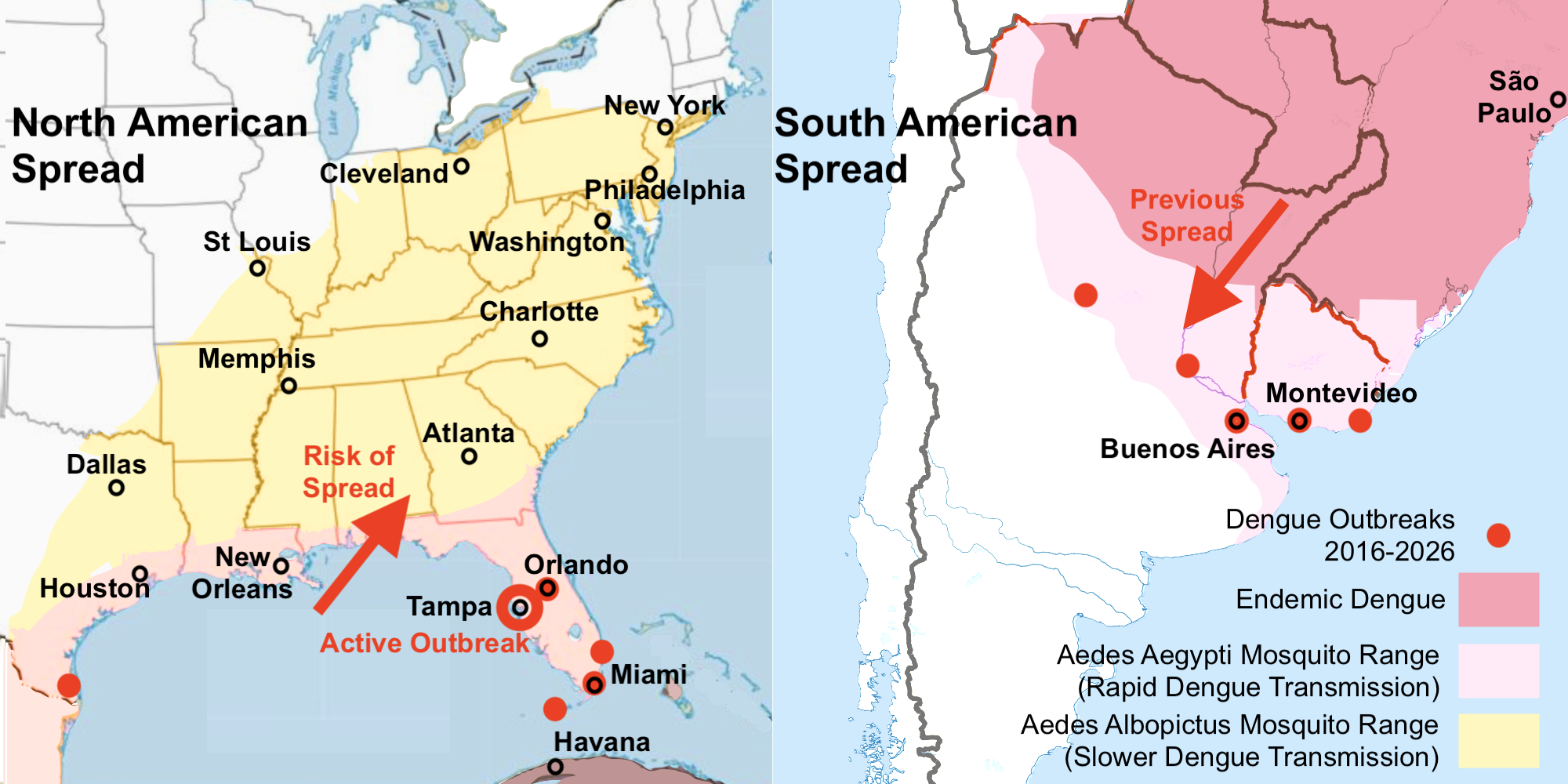
Enemy at the Gate By David G. Young Washington, DC, September 29, 2026 -- Tropical diseases were eradicated from the United States more than a century ago. Those days will soon be behind us. Three Florida counties declared a state of emergency over dengue fever last week -- for good reason. The Tampa metro area had recorded 38 new cases in a week, brining total transmissions to 180. 1 With more than a month remaining before lower temperatures will slow mosquitos, 2026 is bound to be the all-time record year for dengue transmission in the United States -- surpassing the previous record 199 cases in 2023. Only one person has died so far, an 80-year Tampa woman, but a local TV station reported that Tampa General Hospital have treated more than 100 cases.2 Dengue Fever is spread by the aedes mosquito which also carries related diseases like Yellow Fever, Zika and West Nile. Dengue has plagued tropical areas of the Americas for centuries after the aedes aegypti mosquito hitched a ride on slaving ships. Periodic outbreaks of dengue and related tropical diseases once hit as far north as Philadelphia and New York. But because host mosquitos cannot survive a hard freeze, tropical diseases never became endemic north of Florida and the Gulf, The diseases were quickly eradicated in the United States and then most of the Americas by public health efforts between 1900 and 1970.
Now dengue is back with a vengeance. Brazil and Argentina first faced the resurgence and have suffered the most. Brazil's coastal cities started seeing cases return at the end of the last century. Disease slowly moved south and hit the Argentine capital of Buenos Aires with a brutal outbreak in 2023. A study of blood tests in the city found that about 18% of the population has been infected3 -- about 3 million people in the metro area. Now that same process is spreading the disease north from Florida toward more temperate cities in the U.S. To understand why the disease is spreading again, it is critical to understand how America beat it before. Back in 1900, Walter Reed, a U.S. Army doctor confirmed that Cuba's locally endemic yellow fever was spread by mosquitoes. That revolutionary discovery spread like wildfire, enabling suppression efforts for the construction of the Panama Canal. William Gorgas, the Chief Sanitation Officer for the project, relentlessly destroyed mosquito breeding areas, eradicating yellow fever in Panama by 1904. This successful program was then applied to North American cities. Just one year later, yellow fever was eradicated in the United States after New Orleans suffered the final outbreak in 1905. The use of insecticides like DDT were added to the anti-mosquito arsenal during World War II, keeping tropical disease casualties in the Pacific theater minimal. Then the Pan American Health Organization started an aedes aegypti eradication campaign, combining massive aerial spraying of DDT with Panama-style tactics to great success. By 1958, Brazil had eradicated the aedes mosquito according to the World Health Organization, as did many other South American countries over the next decade including Argentina.4 Then things started to fall apart. Aedes aegypti mosquitos in Trinidad became resistant to DDT. Then the environmental tome Silent Spring was published in 1968 and public opposition to DDT ended eradication efforts. Surviving Aedes mosquitoes began expanding again. With a lifetime range of just 150 meters, mosquitos move slowly but surely. It took 50 years, but Aedes mosquitoes have fully re-populated the Americas. Several big changes took place in our dengue-free century, many benefitting the mosquitoes: the Americas' human host population is now six times larger. A proliferation of concrete basins and plastic litter have multiplied stagnant water breeding sites. Climate change has made killing freezes less frequent and shifted them further from the tropics. And in North America, the 1980s arrival of the Asian Tiger Mosquito (aedes albopictus -- a cold-hardy cousin of aedes aegypti) has expanded the range of aedes all the way to the Canadian border. It is only a matter of time before dengue fever becomes endemic in Florida and the Gulf Coast. All that is needed is for enough infected mosquitoes in an outbreak like in Tampa to survive the winter. Dengue will then be an annual phenomenon. Northward expansions will be certain but slower, as the northerly Asian Tiger mosquito spreads Dengue less quickly. The worst-case scenario is "vertical transmission." That's when dengue starts surviving northern winters in mosquito eggs, allowing the disease to become endemic to the Canadian border. Fortunately, most people survive dengue. Yellow fever, spread by the same mosquitoes, is much more deadly. Its return has been prevented to date only by a highly effective vaccine. While new vaccines are also available for dengue, they are less effective. Sadly, the rise of the anti-vaccine movement will hamper the fight against both diseases. Complacency is perhaps the biggest problem. Every native-born American grew up in a country free of tropical disease. Sadly, those days will soon be behind us. Related Web Columns: The Summer of the Mosquito, March 19, 2024 Notes: 1. Florida Department of Health, Florida Arbovirus Surveillance, September 19, 2026 2. Fox 13, Multiple Tampa Bay Area Counties Declare Local States of Emergency as Dengue Fever Cases Rise, September 24, 2026 3. American Journal of Tropical Medicine and Hygiene, Dengue Outbreaks and Antibody Seroprevalence in Buenos Aires, August 5, 2025 4. American Journal of Public Health, Leaking Containers: Success and Failure in Controlling the Mosquito Aedes Aegypti in Brazil, April 2017 |
 SITE
INDEX SITE
INDEX |
|
 |
Home |
|
|
Archives |
|
Identity
Theft |
|
Social
Security |
|
Canadian
Drugs |
|
Iraq |
|
|
|
Search |
|
Travel Pages |
|
Central
Asia |
|
Guatemala |
|
India |
|
Peru |
|
|
|
Personal |
|
Summer Calendar |
|
Feedback |
 |